
November/December 2009 – Water Efficiency Magazine Measuring and Managing Making Sense of Implementing New Metering TechnologyFlorida Power and Light’s voluntary load-management program, On-Call®, which allows the utility to turn residential customers' appliances off when needed to reduce load in exchange for a bill credit, employs Aclara’s TWACS technology demand-response solution. July/August 2009 – Water Utility Infrastructure Management Advanced Metering Accurate Meter Reads are Just One of Many MeritsAvant Marketing Group in Olivette secured $25.2 million in stimulus funds for two of its clients and and ESCO Technology’s Aclara unit expects to indirectly benefit from some of its clients sharing the funding.
Whether handled by legacy systems or third-party products,
data collection and access capability has been a staple of the
utility industry for years. Modern-day meter data management
systems, however, have crossed into territory that has reshaped how utilities are able to assemble, dissect and act upon gigantic volumes of information.
Utility managers representing diverse customers such
as investor-owned utilities PPL Electric Utilities and APS, and large rural utility Umatilla Electric Cooperative, are meeting this week at the headquarters of Aclara Software Inc. in Wellesley to kick off the Aclara MDMS Working Group. July/August 2009 – Water Efficiency Metering and More How Leesburg, VA, Slashed Water LossesThe Leesburg Department of Utilities learned first-hand that modern versions of automatic meter reading (AMR) lead to greater efficiency and conservation. Its wireless, fixed-network metering system helped cut unaccounted-for water from approximately 15% to 7%.
Fixed-network metering was part of a larger, multi-dimensional campaign that helped Leesburg reduce unaccounted-for water from a high of 23% to 3%. It was a smart conservation move that made the utility more accountable to our citizens, our customers, and our town leaders.
Aclara announced its strategic alliance with Firetide Inc., a provider of wireless infrastructure mesh networks. Aclara is developing a revolutionary wide-area network (WAN) for utilities based in part on Firetide's technology.
What is described as a revolutionary, mesh-based wide area network (WAN) for utilities has been introduced by intelligent infrastructure solution provider, Aclara.
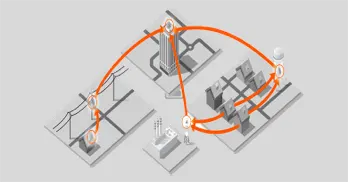
The Aclara Smart Communications Network, which is designed for use by gas, water, or electric utilities, is a high bandwidth, standards-based, broadband solution that will bring together existing utility assets and applications into a single network.
August 7, 2009 – Metering International E-News 11 August 2009 Pepco Holdings to deploy energy management software for customers Software applications present real, actionable information to customersPepco Holdings Inc. is to deploy Aclara’s load and rates analysis and carbon footprint calculator modules to help customers understand how they are using energy as well as how their usage affects the environment. May 29, 2009 – Industry Update from Chartwell’s Smart Grid Research Series. PPL maintains most comprehensive online energy management program “Chartwell believes PPL’s online program, like many other if its programs, is a best practice.” "PPL Electric Utilities is a pioneer among large, investor-owned utilities when it comes to smart metering. It was the first large utility (aside from Puerto Rico Electric Power Authority) to implement advanced metering infrastructure (AMI) on a scale exceeding 1 million endpoints. In fact, PPL has installed about 1.4 million residential and commercial endpoints, nearly all customers. For its project, PPL installed Aclara’s TWACS, a solution that utilizes power lines for communication."
"Starting in 2002, PPL began its 2.5-year installation project, which was completed on-time and on budget. Yet, while the utility was receiving hourly interval data, it had no way to use data for new business applications. In 2005, PPL embarked on a project to implement a meter data management system (MDMS) that would serve as a repository for its metering data; perform validating, editing and estimating; and use the data for various analytic business applications. As a result, PPL chose Aclara’s MDM, which included several analytical tools."
"Among the many applications and benefits PPL is obtaining through its metering data, PPL stands as the only large utility that is offering all customers - small residential to large commercial - access to their usage information online."
"Both customers and CSRs have access to the interval data, although CSRs also get access to the billing data."
Kim Williams didn’t really think she would be studying pie charts and graphs on a regular basis. But several times a month, that’s exactly what she does when she logs into her Pennsylvania Power & Light (PPL) Energy Analyzer account website.
“Since I’ve started checking the site, we have lowered our costs substantially...,” says Williams. “
Williams is just one of the 47,000 visitors to the site the utility company receives each week. Since PPL has equipped each of its 1.4 million customers with new “smart meters,” and then rolled out their interactive Energy Analyzer in the summer of 2007, the number of users has increased by a whopping 800 percent. Since PPL Electtric Utilities introduced Energy Analyzer, nearly 20 percent of their 1.4 million electricity customers have explored the application to learn more about their electricity use. Many then used the information they found to spur changes in their consumption. In fact, PPL's web-site experience offers proof that, indeed, knowledge saves power.
NYC Mayor Michael R. Bloomberg announced that the city had started installing an automated water meter system that is intended to make the quarterly water bill a thing of the past, and not something to fear.
Mayor Bloomberg, Department of Environmental Protection Acting Commissioner Lawitts and Department of Information Technology and Telecommunication Commissioner Cosgrave announced today that citywide installation of automated water meter reading technology has begun. The new wireless equipment will end the use of estimated water bills, giving homeowners and small businesses more accurate and timely records of usage - increasing their ability to identify how they can conserve water and reduce water bills. The college town of Ann Arbor, Mich., home to the University of Michigan and well known for Wolverine football, is also home to a state-of-the-art water system that offers its 114,000 residents cost-of-service rates that are supported by automated meter reading (AMR). Ann Arbor’s holistic approach considers how water, storm water and wastewater operations interact to affect the functioning of the system as a whole. This basic approach has resulted in leading-edge improvements that have benefited customers.
My husband and I still have an extremely antiquated utility meter at our home, which is hidden inside one of our basement closets. As a result, if we’re not home, our monthly bill is a matter of guesswork on the part of Public Service Enterprise Group (did you know that’s what PSEG stands for!), which makes for some pretty bizarre fluctuations. Ah, the joys of living in a small town where infrastructure improvements usually reach last. (Sigh.)
I thought about this when I received a couple of news releases over the past few weeks from software company Aclara, which has developed several applications that let residential and commercial customers monitor and manage their energy bills.
Summer 2008 – City of Alcoa Electric Department - Alcoa Utility Lines Quick TWACS Fact
In May, the Meter Division installed about 1100 new TWACS (Two-Way Automated Communications System) meters, bringing the total installed to 21,000. Work is complete at the five electric substations and they are now “TWACS ready”. Meters are now being entered into the software system to enable remote meter reading and automated billing. The first
meter routes to be automated are undergoing parallel readings to make sure everything works properly. The first bills will be rendered from the new system in the Summer. December 20, 2008 – Boston Globe The Main Attraction With gizmos and grit, technicians detect leaks, protect labyrinth of water pipes under BostonAs a cold rain slanted into his eyes, Mark Collins stood ankle-deep in a muddy puddle in a hole about 6 feet below ground. Just another day and another hole for a job that keeps him digging - and keeps the pipes of the city in good shape.
"The colder it is, the harder it is to dig," he said as he shoveled dirt and rocks this week in an effort to repair a leaky water pipe beneath a Roxbury sidewalk. "But someone's got to do it."
Every day, city residents use nearly 70 million gallons of water, which swishes through more than 1,000 miles of underground pipes. When one breaks, as occurred this week beside City Hall, hundreds of thousands of gallons of water seep into the ground and flood surrounding streets, damaging property and raising water costs for everyone in the city.
Over the past decade, as erosion and widespread construction have weakened aging pipes, city officials have poured $335 million into replacing and repairing the system. Part of the money has paid for the work of a crack squad of hole-digging, sound-detecting technicians such as Collins, who spend their shifts scouring the city for leaks and patching them to prevent breaks.
With the aid of technology - sophisticated sensors and computers have mostly replaced the old stethoscope-like devices that listened for leaks from the street - Boston has kept the number of water main breaks to significantly lower levels than similarly sized cities and helped conserve water.
In his weekly Internet address on Saturday, President-elect Barack Obama provided more detail about his economic recovery plan that will be rolled out in the coming weeks, and when he takes office and Congress reconvenes in January. Betsy Loeff, contributing writer
Here's a bit of irony: I'd planned to write about how electric utilities are using advanced metering and other technologies to deliver better customer service by speeding up restoration when power is out. And, just as I sat down at the computer, the power went out. Right then, I knew my story's premise was spot on: Improving restoration times does, indeed, translate into better customer service from electric utilities. …The team at Mid-Carolina Electric Co-op (MCEC) can ping their 50,000 customer meters to pinpoint trouble spots or verify if outage calls require a technician's visit. "There are any number of reasons we can get an erroneous telephone report about an outage," notes Lee Ayers, system engineer for MCEC. He says it's not uncommon for people to hit wrong buttons when interacting with the interactive voice response system, and it is IVR calls that feed the utility's outage-management system. (MCEC’s outage management is provided by Aclara.)
PPL Electric Utilities has introduced a new feature on its Web site that allows customers to track their hourly energy use on the Internet.
The Allentown company's customers have been able to track their daily electric use since last year. But the new feature that shows hourly electric use can help customers experiment with energy saving efforts, such as lowering the temperature on thermostats for electric heaters, to see what kind of difference it makes, PPL said. NEW YORK (AP) _ New York City says a $68 million effort to modernize its water meters will help save money and water by flagging leaks fast.
The Department of Environmental Protection announced plans Wednesday to install a wireless, automatic meter-reading system citywide.
The network will measure customers' water use four times a day. Readings are now taken four times a year, meaning leaks sometimes linger undetected.
DEP says a leaking toilet can waste 250 gallons a day _ about $640 a year.
The agency says the new system will spot spikes in water use and alert customers to check for leaks. It's expected to take three years to install.
DEP says staff meter-readers will shift to other tasks. The agency also pays Consolidated Edison to read meters but expects to stop.
|